Managing a medical practice is more than diagnosing and treating patients. Every successful appointment is accompanied by a stream of administrative tasks: scheduling patients, processing payments, maintaining health records, submitting insurance claims, staffing, and ensuring compliance. Though all of these workloads are important, they can easily take over a physician’s office and get away from the fun part of being a doctor taking care of your patients.
This is the domain of practice management software. Practice management software serves as the digital backbone of a contemporary healthcare setup, ensuring that all work can be done efficiently. From there, almost all work is handled in person by the physician at a patient’s office. Every activity, from appointment reminders to invoicing, is designed to maximise efficiency between the two parties involved in the doctor-patient relationship.
By minimizing administrative work for doctors and eliminating any repetitive or non-value-adding steps, they are given the capacity to focus on what they love: practising medicine. The market is now cutting-edge and in a state of constant flux. The very existence of practice management software in a practice is not a luxury-it is an endeavour toward an organization ready for patients and ready for tomorrow.
Checklist for Successful Practice Management Software Use
Before discussing the benefits of practice management software, it would be worthwhile to examine its most important features, which should facilitate your decision-making process.
Easy Appointment Scheduling
Patients must be allowed to schedule appointments online, with instant confirmations and reminders provided.
Electronic Health Record (EHR) Integration
The software connects easily with patient health records.
Billing and Insurance Handling
The software, then, must be capable of creating invoices automatically, filing claims, and keeping track of invoices all in one place.
User-Friendly Dashboard
The dashboard should be easy to use for all doctors and staff with minimal training requirements.
Reporting and Analytics
The reporting feature should give live access to real-time financial information for visits and performance.
Compliance and Security
The software must be compliant with HIPAA or similar standards for protecting patient data
Multi-Device Access
Practice management software is open-source, allowing it to be used on any type of device for maximum efficiency.
Once these features are in place, practice management software will become the focal point, keeping the medical practices organized and efficient.
Benefits of Investing in Practice Management Software
1. Streamlined Appointment Management
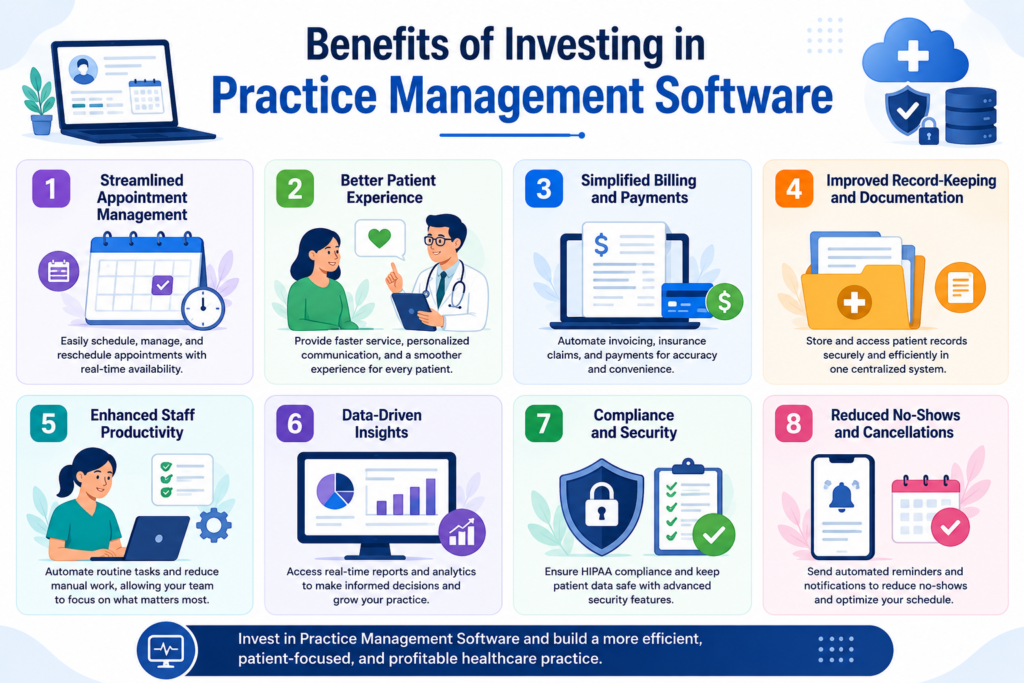
Some of the biggest operational hubs in clinics are patient appointment operations. Missed calls, double-bookings, and no-shows can be a back-and-forth matter; all software does is to reduce human errors and enable automated scheduling with appointment reminders.
Patients can schedule their appointments with little to no problem. This leaves staff members free to focus on the practice, saving hours of repetitive work.
2. Better Patient Experience
Today, patients have become accustomed to instant communication with their providers. They want to schedule appointments at any hour. They demand reasonable timeframes for responses and shorter wait times at your office. Establishing a clean and clear experience will foster patient-provider trust and loyalty.
3. Simplified Billing and Payments
The medical billing process can be complicated and nearly impossible to navigate if the services are billed to insurance. When billing is handled manually, there is a likelihood of errors or claim rejections.
Practice management software is able to streamline the entire manual process, allowing for faster payment cycles while enabling patients to pay in multiple ways. Reducing stress is good for both the clinic and the patient.
4. Improved Record-Keeping and Documentation
The healthcare industry relies on having an accurate and properly organised record-keeping system. Any information regarding an individual, from demographic data to lab results, can be collected within a digital system in a single, secure location.
When a doctor meets with a patient, they have instantaneous access to the patient’s records, allowing them to confirm the accuracy of the clinical decision and treatment.
The doctor can then make an accurate clinical decision based on the information provided by the records. Additionally, storing the records in the cloud provides an extra layer of protection against data loss.
5. Enhanced Staff Productivity
There are times when administrative staff may spend hours performing routine management tasks, such as billing and sending reminders to patients. With an automated billing or patient-referral reminder system, these inexpensive activities can be leveraged for other high-value initiatives, such as patient relations within the practice or care coordination. This will improve the productivity of the practice and ease the workloads across the physicians.
6. Data-Driven Insights
Running a medical practice is similar to running a business; success depends on data. The use of practice management software will enable the doctor, as well as other key staff, to analyze information about revenue, appointment trends, and patient behavior, and this information will be easily accessible in reporting. This will enable the doctor to understand any gaps in the practice, apply best practice methods to their services, and grow their practice more strategically.
7. Compliance and Security
Preserving patient confidentiality is critical in a healthcare environment. An effective practice management system should provide encryption tools along with robust security protocols for highly sensitive data. Practice management systems that maintain compliance with healthcare regulations also reduce the risk of legal and/or reputational issues.
8. Reduced No-Shows and Cancellations
Missed appointments can negatively impact both the patient experience and the potential revenue collected by the clinic. Sending reminders automates the process, reducing missed appointments more than you might think, while also providing easy options for rescheduling and filling cancelled events.
In addition, reminders will have a positive impact on patients while they are at the facility, as they support a more consistent flow of patients through the facility, which should lead to increased financial benefits.
Use Cases of Practice Management Software in Healthcare
1. Solo Practices
Solo physicians or practitioners frequently need to manage both clinical responsibilities and administrative responsibilities or related duties. With software, they can automate monotonous tasks (e.g., billing, scheduling), which gives them back valuable time to focus on patients without the need for extra employees.
2. Multi-Doctor Clinics
If several doctors work under the same roof, confusion can arise, especially when considering patient provision and provider availability. A centralized system helps to organize coordination among doctors, front desk administrators, and patients.
3. Specialty Practices
The specialists (dentists, dermatologists, physiotherapists, etc.) would regularly find ways to operate peculiar to their field. These custom features, such as tracking treatment plans or follow-up appointments, would help ease patient care.
4. Hospitals and Large Facilities
In larger organisations, practice management software becomes an integral operational system at the core of the organisation. It helps manage larger volumes of patients, facilitates insurance processing, and ensures compliance across multiple departments.
5. Telemedicine Integration
As telehealth services become increasingly available, software platforms offer video consultations, online payments, and prescription services. This allows remote visits to happen, easily, in a more professional format.
Conclusion
Patients are the foundation of every doctor’s practice, and patient care is the primary priority of the care provided by the doctor. While Healthcare Digital Marketing Services in India help medical practices reach more patients online and strengthen their digital presence, administrative responsibilities can still make it challenging for doctors to keep patient care as their top priority. Effective practice management software complements these marketing efforts by introducing efficiency, accuracy, and increased patient satisfaction. It creates an organized workflow, allowing physicians to focus on what they do best—providing quality care—while ensuring the practice operates seamlessly.
This is where Patient On Click adds value. We do more than just help physicians adopt a practice management tool that can improve patient care we consult with physicians to develop the best strategies to optimize the practice’s growth through smart marketing and technology. Partnering with Patient On Click will accomplish measurable growth by combining technology and physician marketing expertise.
Let Patient On Click help turn your practice into a modern healthcare brand, an efficient, patient-centered business!