Have you noticed how some oncology practices become magnets for online patients, while others have less online visibility? You cannot assume that expertise in cancer care makes you visible in any digital-first world. Patients are answering their questions long before they book an appointment, so it’s imperative to build trust and connection in all online interactions.
Oncology practices need to think thoughtfully about digital marketing strategies that stretch beyond just promotions. From Google rankings to educating patients through compassionate stories on social media, every online interaction is a construct of patient perception. Think about a website that anticipates patients’ questions, articles that break down complex medical testimonials, and campaigns that are timed just right when patients are searching.
Digital marketing provides a constructive bridge between your expertise and the people, patients, and loved ones who rely on it. This blog discusses actionable strategies for oncology practices to build visibility, nurture trust, and have a positive, meaningful patient engagement.
Checklist for Successful Oncology Marketing Campaigns
Before launching any strategy, it’s critical to establish a strong foundation for your oncology marketing initiatives:
- A responsive, patient-centric website that functions effectively on different devices.
- Comprehension of the healthcare advertising standards as well as conformity with HIPAA and privacy stipulations.
- Being respectful and compassionate towards the patient.
- Analytics tracking to measure engagement, distance, and other actions.
- Easy access to complimentary online appointment booking and support.
- Maintaining a watchful eye on reviews, patient mentions, and social media.
Ways to Market Oncology Practices Digitally
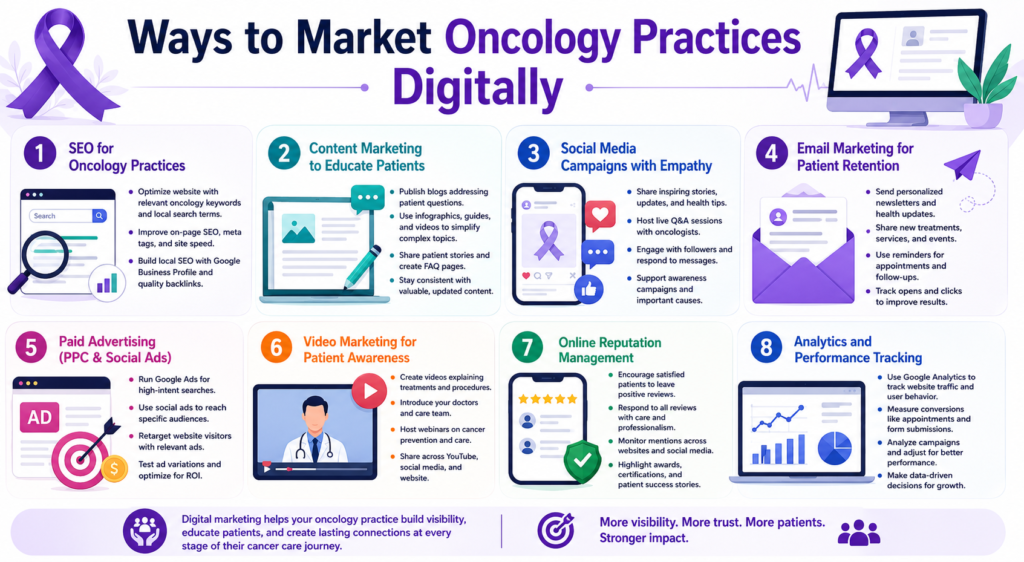
1. SEO for Oncology Practices
Organic search is one of the strongest channels for patient acquisition. As a core part of an effective oncology digital marketing strategy, optimising your oncology practice’s SEO helps your website become more visible to patients searching for cancer-related information, treatments, and specialist care.
- Incorporate location-related terms such as “oncologist in city” or “cancer care near me” into the oncology keywords.
- Optimize metadata, headers, and photo/graphics alternate text to improve rank.
- Build a strong local SEO presence utilizing Google Business Profile (formerly Google My Business) as well as claim accurate NAP data.
- Use schema markups to present your services in rich results on Google.
- Keep updating your content frequently with the latest treatments and educational resource information.
2. Content Marketing to Educate Patients
Patients and families require credible information to make sound decisions. Providing useful information in clear, easy-to-understand language has helped establish your practice as a reputable source.
- Publish blog entries that attempt to answer some of the questions that patients may have regarding treatment, symptoms, or prevention.
- Provide infographics or visual guides to ease complex medical information.
- Write about anonymous patient stories or treatment journeys to inspire.
- Create FAQ (Frequently Asked Questions) pages to provide more thorough responses to frequently asked concerns.
- Publishing on a time schedule allows you to remain at the forefront of patient care as well as be relevant.
3. Social Media Campaigns with Empathy
- Social media offers your oncology practice an opportunity to showcase its human side. To forge emotional bonds with patients and their families through storytelling, social engagement, and communication is utilised.
- Social media becomes a handy tool when integrated with a launch campaign, utilising platforms like Facebook, Instagram, or LinkedIn.
- A survivorship story, testimonial, or healthy living tip all serve as sources of inspiration and motivation.
- Let’s not underestimate the value of hosting a Facebook or Instagram live Q&A, where your oncologists can directly respond to questions about oncology and cancer care in real time.
- Engaging with patients by responding to their comments and messages fosters relationships and cultivates trust.
- Contribute to national awareness months to support causes, such as Breast Cancer Awareness Month.
4. Email Marketing for Patient Retention
- Email remains one of the most personal and effective methods for communicating with patients to educate and keep them connected about pertinent information related to the practice.
- Send personalised newsletters to patients based on their interests or stage of treatment.
- Inform patients about all new treatments to the practice and any changes (service delivery updates) to existing ones.
- Utilize reminders to have patients recall appointments, follow-up recommendations, or additional care options they may want to consider after treatment.
- Support material to encourage a healthy lifestyle.
- Use opens and clicks to ensure the email remains effective.
5. Paid Advertising (PPC & Social Ads)
Paid advertising campaigns create opportunities for your practice to be placed before patients searching for oncology care and, when done well, give measurable results.
- Need more proof of “high-intent” advertising? Think about running a Google Ad for a search like “cancer hospital near me.”
- Social Ads can work well for particular age groups, geographic areas, or types of patients in oncology.
- Consider retargeting previous website visitors with a targeted message.
- Consider testing different ad formats and ad copy with an A/B test.
- Monitor conversion rates after running Google Ads or social media ads to adjust spending and optimise for the highest return on investment.
6. Video Marketing for Patient Awareness
Videos resonate well with audiences, making complex healthcare information easier to grasp. They develop trust by providing faces and voices to your practice.
- Create short explainer videos to address questions you often hear about treatments and procedures.
- Consider recording introductions of your doctors or other healthcare team members.
- Consider hosting and advertising webinars that provide cancer prevention and early detection tips, or provide updates on cancer treatment.
- Offer captions or accessible modes so hearing-impaired patients do not lose the benefit of your investment.
- Distribute the videos across multiple platforms, such as YouTube, social channels, and your own website, to reach a wider audience.
7. Online Reputation Management
Online reputation management is serious, especially in healthcare, because trust is imperative, and for many people, online reviews are the first impression they will have of your practice in these cases. Actively managing your reputation can help attract more patients.
- Consider asking your satisfied patients to take the time to leave a review about your practice online, especially on Google or in local or medical directories.
- Consider the patient’s feelings when responding, whether positive or negative.
- Regularly check practice mentions out in review sites, comment sections, or social media platforms.
- Publicise industry recognition or certifications or awards on your site.
- Ensure your branding and messaging are consistent across all online platforms.
8. Analytics and Performance Tracking
If you do not have the tracking in place, it will be difficult to know the results for your work. The analytics are used to reevaluate tactics and reinforce patient engagement.
- Utilise Google Analytics to gain insight into website traffic and visitor behaviour.
- You can measure conversions such as completing a form or scheduling an appointment.
- You can review ad campaigns and determine if adjustments can be made to your targeting.
- You can continue to evaluate progress and engagement on social media.
- With these analytics, you can make data-driven adjustments to reevaluate ROI and refine your campaigns as needed.
Conclusion
The term “digital marketing” will have specific meanings for the various stakeholders involved in oncology practices; however, it is imperative to recognise that visibility is not important – what is important is the trust and the process of supporting and nurturing patients through one of the hardest journeys they will experience. Every chance to communicate with a prospective or current patient, whether through a Google search, social post, or marketing email, signifies a potential opportunity to truly connect.
By establishing an integrated marketing plan that incorporates SEO, content marketing, social engagement, and reputation management, your practice can establish a strong digital footprint. Not only will prospective patients learn about your practice, but they will also feel the compassionate care in the services provided.
At Patient On Click, we provide health care-centric digital marketing services. Our staff combines creativity, technology expertise, and a patient-first positioning approach to ensure your practice reaches the right patients at the right time. Whether developing responsive websites and optimising search engines, or designing the next educational campaign, our knowledge and experience is that patient engagement will enable oncology practices to dominate the digital space and grow their practices with conviction.